Speed to lead predicts conversion more than almost any other metric — and most teams can't see how slow they really are, because no single system tracks the delay across every source.
Real estate has one of the most unforgiving response-time curves of any sales category. A buyer who submits an inquiry is usually comparing three or four options in the same hour. The developer or agent who calls back first has a measurable, well-documented advantage — and the one who calls back six hours later is often calling a buyer who's already spoken to someone else.
Why Response Times Slip Even on Good Teams
It's rarely that nobody wants to respond fast. It's that leads arrive from five or six different channels — a Facebook ad, a walk-in, a portal like MagicBricks, a referral, a cold call list — and land in five or six different places before anyone consolidates them. By the time a lead is assigned to the right agent, meaningful time has already passed, and none of it shows up as "slow" in any single system, because no single system saw the whole delay.
The Metric That Actually Matters: Time to First Contact
Most teams track whether a lead was eventually contacted. Few track how long it took — Time to First Contact, or TTFC. TTFC is the number that correlates with conversion, and it's invisible unless a system is explicitly measuring the gap between "lead created" and "first logged interaction," across every channel, automatically.
What Actually Closes the Gap
- Instant routing on arrival. A lead shouldn't sit in an inbox waiting for a human to triage and assign it. Routing rules should fire the moment a lead lands, based on source, territory or availability.
- Priority visible at a glance. Not every lead deserves the same urgency. A 0–100 score with Hot/Warm/Cold priority, recalculated as activity happens, tells an agent who to call first without having to read the whole record.
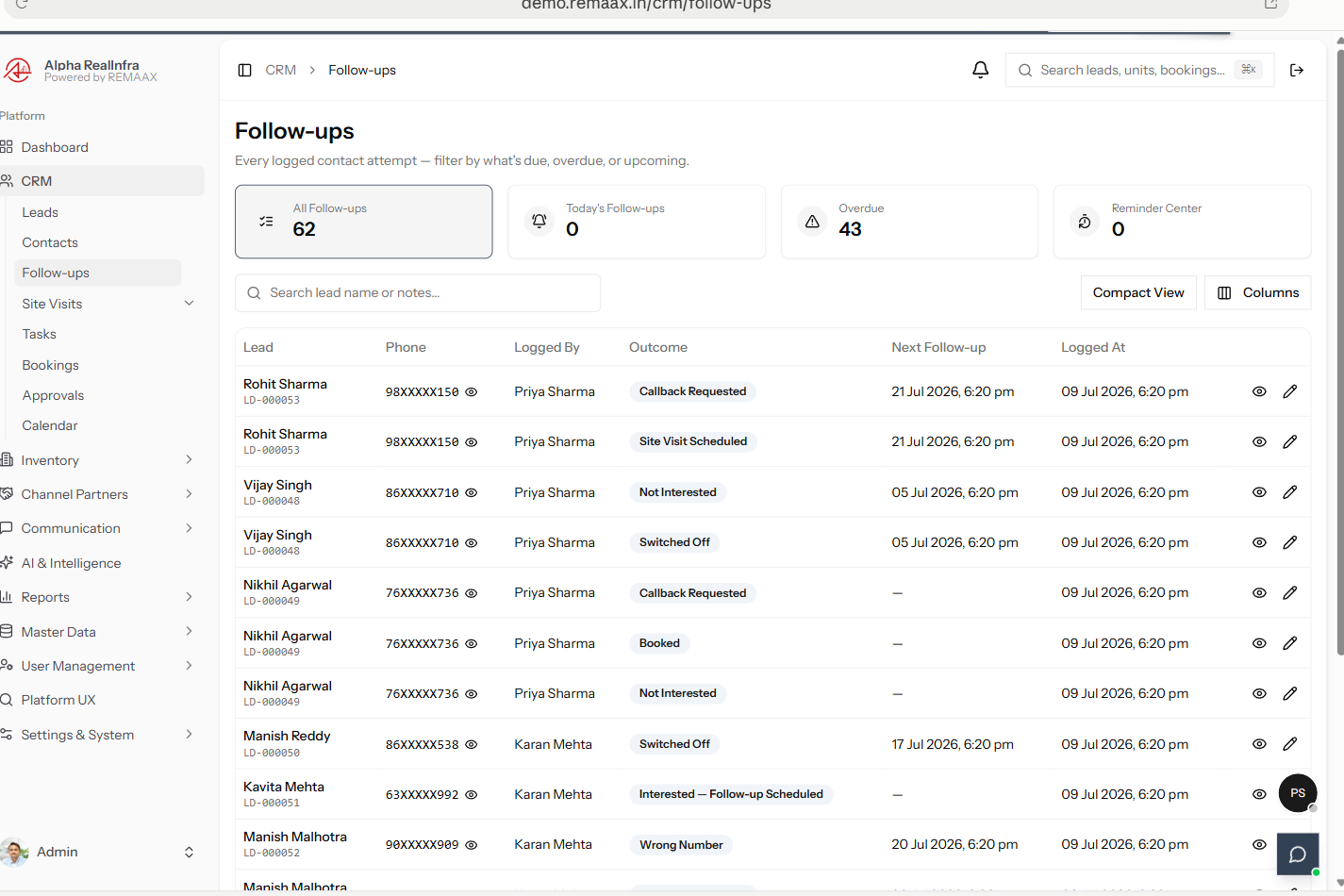
- Overdue follow-ups that surface themselves. If a lead has gone quiet past its expected follow-up window, that should show up on the agent's dashboard automatically — not depend on the agent remembering to check.
- SLA breach visibility for managers. A manager needs to see TTFC breaches across the whole team, not discover them a week later in a spreadsheet review.
What This Looks Like in Practice
In REMEX, every lead — regardless of source — is auto-scored the moment it arrives, with Average Time to First Contact and TTFC Breaches shown directly on the manager dashboard, not buried in a report someone has to generate. Pending and overdue follow-ups have their own stat-card filters, so an agent's first click of the day is straight into exactly the leads that are aging out.
None of this replaces a good sales process. What it does is make sure the process isn't being quietly undermined by a five-hour delay nobody could see.