Explainable scoring beats a black box — a score agents can't interrogate is a score they'll learn to ignore within a month.
"AI lead scoring" gets used as a marketing phrase often enough that it's worth being specific about what it actually does, what it doesn't, and why the explainability of the score matters as much as the score itself.
What Lead Scoring Actually Measures
A good scoring model isn't guessing whether someone will buy — it's weighting a handful of concrete signals that correlate with buying intent: budget fit, how recently and how often a lead has engaged, which source they came from, and how far along the pipeline they've moved. A 0–100 score is a summary of those signals, recalculated continuously as new activity happens, not a one-time prediction made at the moment the lead was created.
Why "Explainable" Matters More Than "Advanced"
A scoring system that spits out a number with no visibility into why is a black box a sales team learns to ignore within a month — nobody trusts, and therefore nobody acts on, a number they can't interrogate. A score an agent can break down — this lead is Hot because of high recency, a strong-fit source, and repeat engagement — is one they'll actually use to decide who to call first.
This is a deliberate design choice, not a limitation: deterministic, rule-weighted scoring that's fully explainable will consistently outperform an opaque model in actual sales-floor adoption, even if the opaque model is theoretically "smarter." A score nobody trusts doesn't change behavior.
Reading a Scoring Dashboard
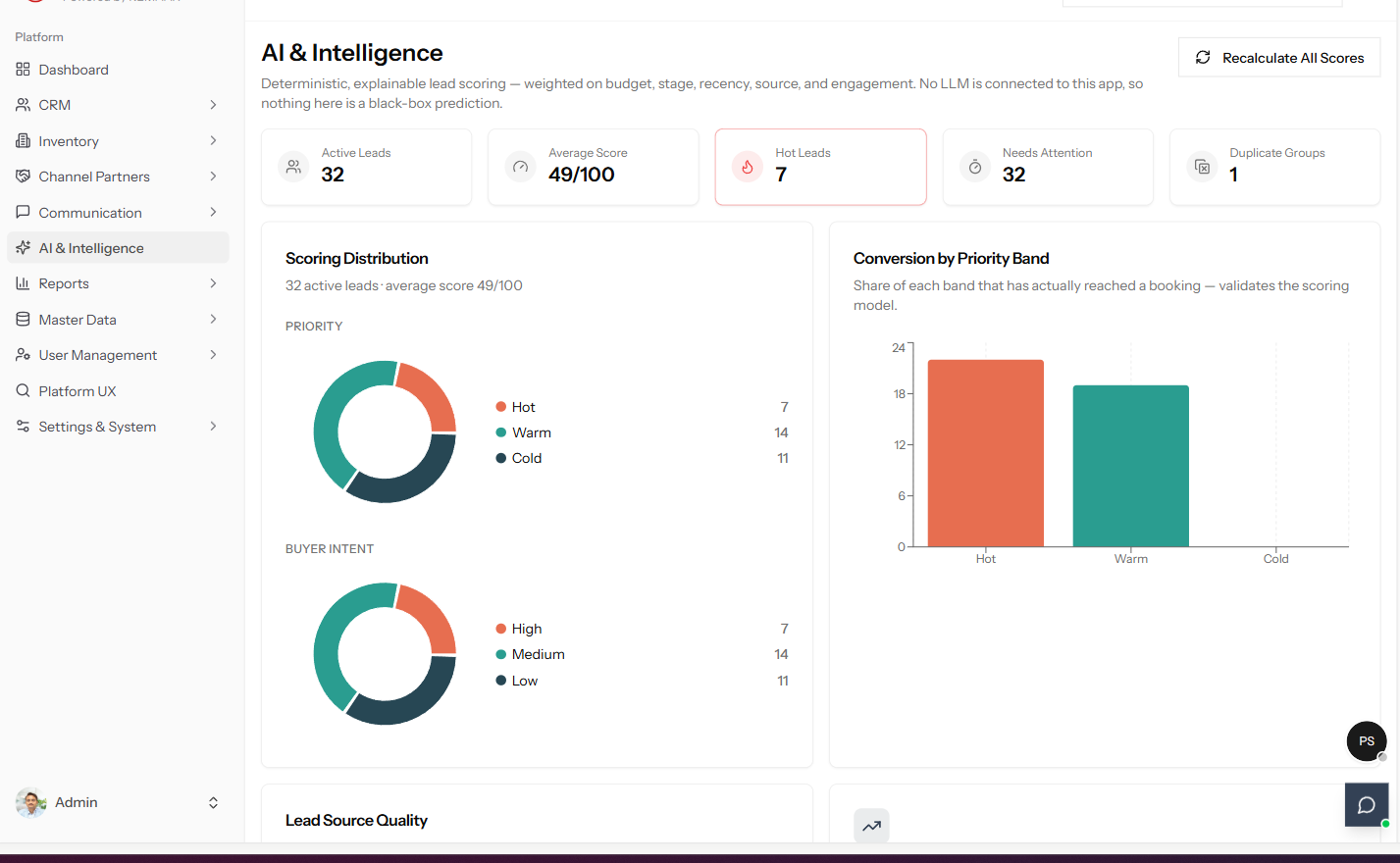
- Scoring distribution — how many active leads fall into Hot, Warm and Cold bands, so a manager can see pipeline health at a glance, not just individual scores.
- Buyer intent tags — High, Medium, Low — separate from priority, because a lead can be high-intent but early-stage, or lower-intent but ready to move fast.
- Conversion by priority band — the number that validates the model itself: if Hot leads aren't actually converting at a meaningfully higher rate than Cold ones, the scoring weights need adjusting.
- Duplicate groups — a byproduct of good lead intelligence: the same detection that scores leads should also catch the same phone number arriving from two different sources.
What "No LLM Connected" Actually Means, and Why It's a Feature
Deterministic scoring means the same inputs always produce the same score, and every score can be broken down into the specific factors that produced it. That's not a limitation compared to a large language model — for the specific job of "rank these leads by buying intent using structured data," a transparent, auditable, consistently-reproducible model is the right tool, not a less capable one.