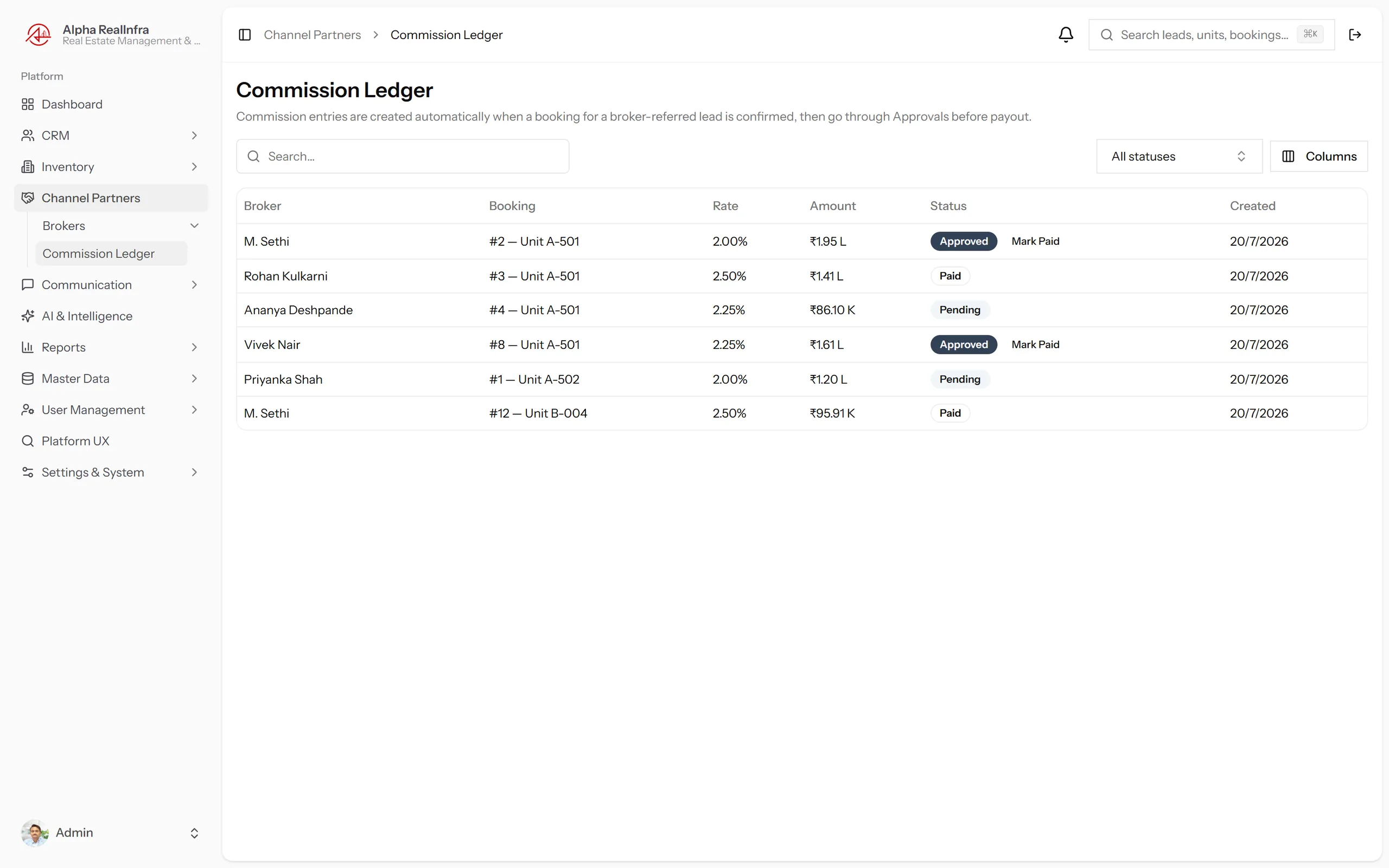
A commission spreadsheet depends on someone remembering to update it. Automation means the entry is created the moment the booking is, using the partner's on-file rate.
Almost every brokerage and developer starts commission tracking in a spreadsheet, and for a small volume of deals, that's genuinely fine. The problem isn't the spreadsheet itself — it's that nothing forces the spreadsheet to stay in sync with what's actually happening in the CRM, and the gap between the two is where disputes live.
Where Spreadsheet Tracking Breaks Down
- It depends on someone remembering to update it. A booking gets confirmed in the CRM; the commission entry gets created in the spreadsheet — eventually, by someone, if nothing interrupts them that day.
- Status has no enforcement. Pending, Approved and Paid are just text a person types, with nothing stopping an entry from being marked Paid before it's actually approved, or approved twice.
- There's no single source of truth for disputes. When a partner says a commission is overdue, resolving it means cross-referencing the CRM's booking record against the spreadsheet's entry — two systems that were never actually linked.
- It doesn't scale with partner count. Ten partners in a spreadsheet is manageable. Fifty, each with different commission rates and multiple bookings a month, is a part-time job for someone.
What an Automated System Actually Changes
The core shift is simple: the commission entry is created automatically the moment a booking confirms, using the partner's on-file commission rate — not typed in later by a human who has to remember the rate and the booking details correctly. From there, it moves through a visible Pending → Approved → Paid workflow that's searchable and filterable, so "which commissions are still pending for this partner" is a filter, not a manual search through months of records.
The Real Payoff: Source Performance Reporting
Once commission data lives in the same system as the leads and bookings that generated it, a question that's nearly impossible to answer from a spreadsheet becomes trivial: which partners and channels are actually converting to bookings, not just referring volume. That's the difference between paying commissions and understanding which relationships are worth investing more in.